Customized Assessment
We evaluate materials against applicable FDA food contact regulations, authorizations, exemptions, and guidance documents to identify regulatory obligations, support compliance efforts, and highlight potential gaps.



Navigate FDA Requirements and Market Expectations with Confidence
Successfully bringing food contact materials to the U.S. market requires a thorough understanding of FDA regulations, regulatory clearances, and chemical safety considerations. Our customized Food Contact Material (FCM) evaluation services help organizations identify compliance obligations, determine appropriate regulatory pathways, and support successful market access.

Our experts assess food contact materials against applicable U.S. Food and Drug Administration (FDA) regulations, Food Contact Notifications (FCNs), Threshold of Regulation (TOR) exemptions, and other relevant regulatory requirements. We help organizations understand regulatory expectations and develop strategies that support their compliance objectives.

We evaluate raw materials, additives, formulations, and intended food contact applications to develop compliance strategies aligned with each product’s composition, intended use, and business objectives.

Our team reviews material compositions, supplier documentation, manufacturing processes, intended use conditions, and relevant regulatory requirements to support compliance throughout the product lifecycle.
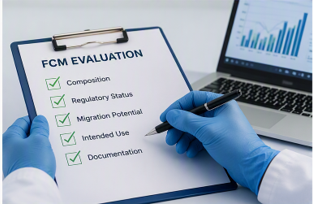
We help manufacturers, suppliers, and brand owners assess food contact materials against applicable U.S. regulatory requirements while supporting product performance, customer expectations, and market access goals.

A Food Contact Material Evaluation involves assessing materials and substances intended to come into direct or indirect contact with food to determine whether their intended use is supported under applicable FDA requirements.
Evaluations may include reviews of:
Organizations introducing food contact materials into the U.S. market are responsible for ensuring their products are suitable for their intended use and supported by applicable regulatory requirements.
A comprehensive evaluation can help organizations:



Dedicated Professionals Supporting Your U.S. Compliance Journey
![1[1]](https://h2compliance.com/wp-content/uploads/2025/01/11.png)
Food contact materials include packaging, containers, processing equipment, utensils, coatings, adhesives, inks, plastics, rubber materials, paper products, and other materials intended to come into direct or indirect contact with food during manufacturing, processing, storage, transportation, or consumer use.
We review the material composition, intended use, food contact conditions, applicable FDA regulations, existing authorizations and exemptions, and supporting documentation to determine whether the intended application is supported under applicable regulatory requirements.
Typical information includes:
Yes. We support both existing commercial products and new product development initiatives. Early-stage evaluations can help identify regulatory requirements, potential compliance challenges, and data needs before commercialization.