


Understanding ECHA CHEM statuses, regulatory milestones and implications for Only Representative clients
Why do we monitor dossier & substance evaluations?
Dossier evaluation is the process through which ECHA checks whether information submitted in a REACH registration meets the applicable requirements for the substance and tonnage band. Dossier evaluation covers compliance checks and the examination of testing proposals.
In addition, ECHA and EU member states conduct Substance evaluations. These go a step further and instead of reviewing the data included in the registration dossier, the authorities look at the actual risks a substance may pose to human health or the environment.
Why Early Visibility Matters
Evaluation may lead to a draft decision and, subsequently, an adopted decision requiring additional information by specified deadlines. This often means additional testing and dossier update work by the lead registrant, and, consequently, triggering additional costs which are shared by co-registrants. Tracking status changes enables timely risk assessment regarding the potential commercial and operational impacts on registrations.
Monitoring allows us to:
- identify registrations subject to dossier evaluation activities or substances subject to substance evaluation;
- understand potential regulatory and financial implications;
- assess whether the registered tonnage band remains appropriate, and/or whether maintaining, reducing the tonnage or deactivating the registration best reflects future business needs;
- prepare for possible testing, data-sharing and dossier update costs;
- remain informed of key developments and regulatory milestones; and
- above all, it lets us share these updates with our clients to ensure that the correct action is taken.
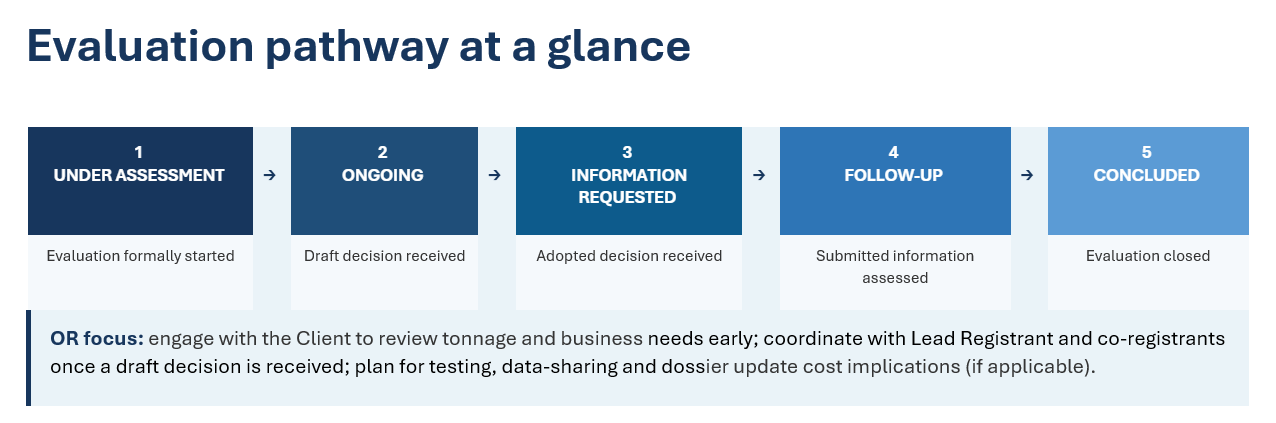
Under assessment – Evaluation formally started
REGULATORY MILESTONE: ECHA has formally started evaluating the dossier. No draft decision has yet been received.
Potential implications
- The evaluation may conclude without a request for further information.
- ECHA may issue a draft decision proposing additional information requirements.
- At this stage, the OR and non-EU manufacturer/formulator still have the greatest flexibility to review tonnage import forecasts and business needs before formal information requests are issued.
Only Representative actions:
Review whether the current tonnage band remains appropriate (assess past and expected EU import volumes). A dossier update to a lower tonnage band can reduce the tests costs implications – as a rule the higher the tonnage band the more expensive the testing.
Review whether maintaining, reducing or deactivating the registration best reflects future business needs.
Note: ceasing manufacture or import at this stage will deactivate the registration (it can be reactivated later to the existing tonnage band without paying ECHA fees, the registrant will be liable for the additional data costs incurred by the registrants (joint submission) during the period of deactivation).
Maintain and monitor Lead Registrant communications to understand the joint submission obligation for future testing and the associated costs.
Ongoing – Draft decision received
REGULATORY MILESTONE: The registrants have received a draft decision. The dossier retains the status “Ongoing” until the decision is adopted, or the evaluation is otherwise concluded.
Potential implications
- Additional information requirements have been proposed.
- Registrants can comment on the draft decision within the period specified by ECHA (30-days).
- The likelihood of testing, data generation, and dossier update work has increased.
Only Representative actions:
- Coordinate promptly with the Lead Registrant and co-registrants on the response.
- Note: Once a draft decision is received, follow up with the Lead Registrant to ensure they are responding to ECHA as comments and options should be considered before the decision is adopted – ECHA allow 30 days for the response.
- Review whether maintaining, reducing or deactivating the registration best reflects future business needs.
- A tonnage downgrade may still be considered at this stage, if a registrant can substantiate that imports have remained within the lower tonnage band and there are commercial reasons for a reduction. This would require documentary evidence supporting the lower tonnage band and a dossier update. The circumstances are assessed by ECHA individually.
- A tonnage downgrade may still be considered at this stage where the registrant can verify that imports have remained within the lower tonnage band. This would require a dossier update and documentary evidence supporting the lower tonnage band.
- Consider carefully the consequences of ceasing manufacture / import after receipt of the draft decision, including registration invalidation.
- Note: ceasing manufacture/import after adoption of the draft decision invalidates the registration (the cost of the initial registration is lost; if the company renews supply of the substance in the future, at new registration will be required).
Information requested – Adopted decision received
REGULATORY MILESTONE: The registrants have received the adopted decision. It specifies the additional information required and the deadline(s) for providing it.
Potential implications
- Review the requested information and submission deadlines in the adopted decision and assess applicability to the Client (based on the tonnage band and role).
- Engage with the Lead Registrant as they will organise the testing on behalf of the co-registrant group.
- Testing, data-sharing, joint submission administrative, dossier update and associated costs.
Only Representative actions:
- Monitor Lead Registrant and consortium activities relating to generation of the requested information.
- Prepare for data-sharing and dossier update costs associated with compliance with the adopted decision.
- Discuss the options of maintaining, reducing or deactivating the registration with the client and determine which of these is most appropriate for future business needs.
- Note: tonnage downgrade of ceasing manufacture/import after adoption of the decision does not remove the obligation to fulfil its requests (registrant remains liable for the related joint submission costs).
Follow-up – Information submitted to ECHA and is under assessment
- ECHA assesses the dossier update against the adopted decision.
REGULATORY MILESTONE: After the deadline, ECHA assesses whether the submitted information corresponds with the data requested. After this assessment a decision on further action is taken – if the information is accepted, the evaluation concludes, if the information is not accepted the case is referred to the national enforcement authorities for follow-up.
Potential implications
- If requested information is missing, ECHA may notify national enforcement authorities.
- Further dossier updates or enforcement-related actions may be required depending on the assessment.
Only Representative actions:
- Continue monitoring Lead Registrant, consortium and ECHA communications.
- Track any delayed studies, agreed follow-up actions and further dossier updates.
- Assess implications for registration maintenance, costs and the supply chain.
Concluded – Evaluation closed
REGULATORY MILESTONE: Evaluation closed. The dossier evaluation has been closed.
Potential implications
- No further action in terms of the Evaluation
Only Representative actions:
- Inform the Client, review and retain the final evaluation outcome and supporting records.
- Follow up with the Lead Registrant and confirm if the Joint Submission members’ fees have been fully shared.
- Continue routine monitoring of other regulatory developments affecting the substance.
Useful Sources
- ECHA – Dossier Evaluation status & Activity List
- ECHA – Dossier evaluation decisions: recommendations to registrants
- ECHA – Dossier evaluation overview
Disclaimer
This document provides general regulatory and commercial guidance by explaining the evaluation terms used in ECHA CHEM and the regulatory milestones behind them. It does not attempt to predict the outcome of an evaluation. The consequences of an evaluation depend on ECHA’s adopted decision and the Joint Submission’s response to it. The Only Representative actions as outlined above incorporate internal H2 Compliance analysis while considering the recommendations of the Only Representative Organisation included in their Best Practice Guide.
Published October 29th, 2026
Article image generated with the assistance of Artificial Intelligence.